
Bring reliable 5G indoors. Every carrier, every device, every time.
Talk to an expertEricsson Radio Dot System delivers high-performance neutral host networks with less infrastructure and complexity
Demand for excellent 5G coverage in buildings is higher than ever. However, most buildings don’t provide the reliable performance that people expect for calling 911 during an emergency, reaching friends and family with timely questions, or simply accessing apps on their personal devices. The architecture of big buildings makes delivering this level of service difficult, plus legacy solutions such as active distributed antenna systems (DAS) carry performance limitations and extensive infrastructure requirements that are less than ideal. Enterprises are turning to small cell neutral host solutions such as the Ericsson Radio Dot System so they can improve and scale their indoor 5G coverage for years to come.
Performance that’s built to scale
One of the best ways to improve cellular performance via a neutral host network is to implement MIMO (Multiple Input, Multiple Output) to increase throughput and reliability. The Ericsson Radio Dot System supports MIMO natively, without adding any infrastructure. The Radio Dot System expedites the signal distribution process, which reduces loss and improves the quality of service, and provides deeper control of specific coverage areas within a building.


Multi-carrier support with less infrastructure
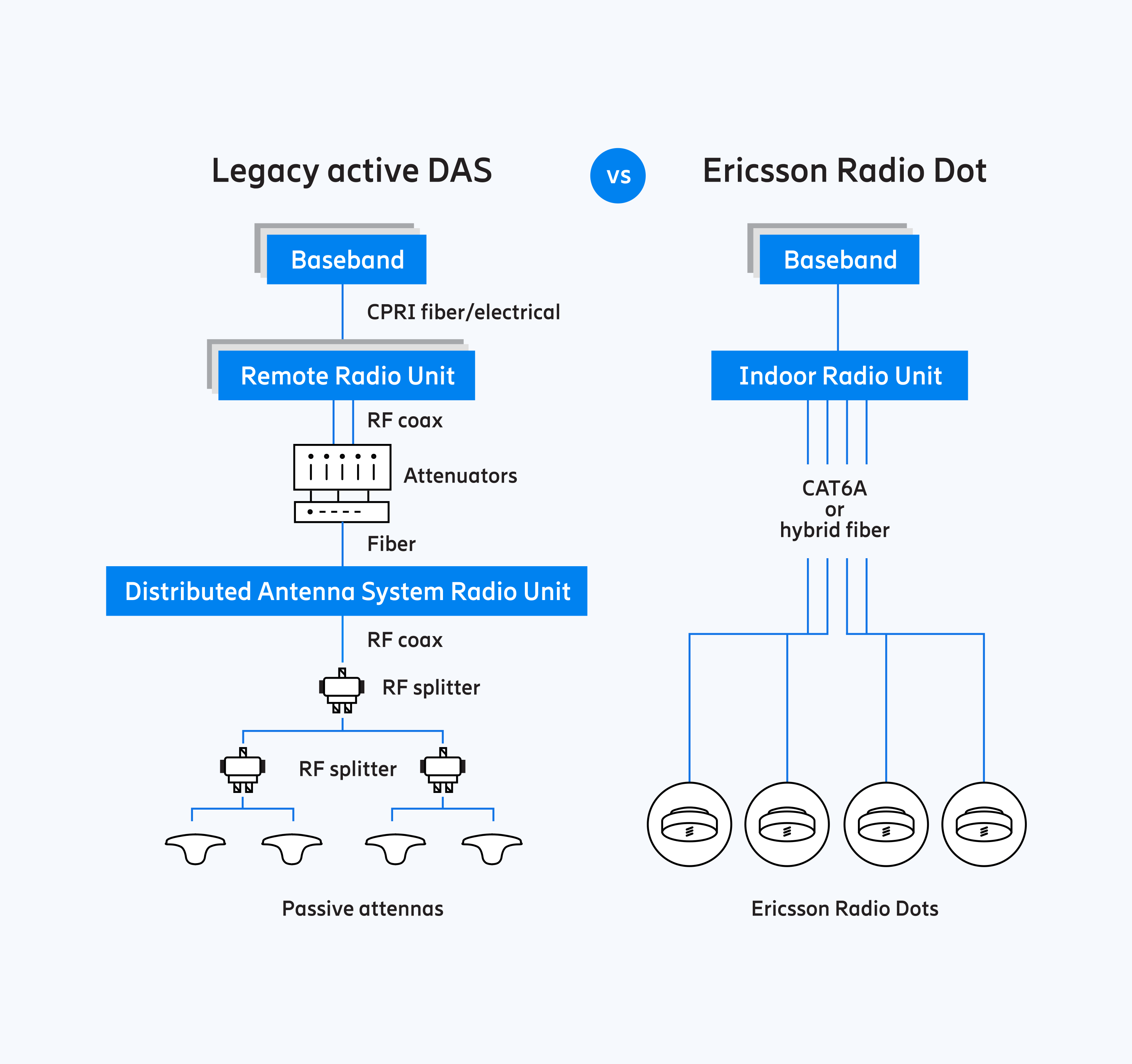
Legacy active DAS requires a significant number of cables, connectors, headend equipment, racks, uninterruptible power supplies, and radios — especially in order to support multiple carriers. Conversely, the Ericsson Radio Dot System is a small cell solution that requires no analog-todigital conversion and features nodes and radios that support all three carriers instead of just one. It can easily scale to more than 10 million square feet, making it an excellent solution for any size of building.
More flexibility to keep improving the network
The legacy, analog-to-digital nature of legacy active DAS makes it very inflexible and quite limited in its ability to support new technologies and features. A small cell neutral host solution such as the Ericsson Radio Dot System supports new features like indoor precise positioning, RedCap, carrier aggregation, and network slicing. This solution also supports 4G and 5G from one set of Radio Access Network (RAN) infrastructure.

10 World Trade establishes indoor 5G coverage that’s built to scale
At the 10 World Trade building, Boston Global Investors and Aspen Venue Partners deployed a solution built to establish excellent indoor 5G coverage from day 1 — without sacrificing performance and scalability.
Streamline your infrastructure with the Radio Dot System
The Ericsson Radio Dot System, working cohesively with basebands managed by cellular network operators, mimics a large outdoor macro cell — but indoors. Also known as a Distributed Radio System (DRS), this solution separates the functionalities:
- The basebands feed into Ericsson Indoor Radio Units (IRUs), where the computing takes place.
- The IRUs process and distribute the signal to Radio Dots at the edge. The presence of multiples nodes, or small cells, throughout a building fosters more intelligence and control of specific areas, with greater performance.
Ericsson ranked #1 in ABI Research DAS/DRS competitive assessment
