

Resilience that actually works
Your backup connection isn't much help if it takes minutes to kick in. Intelligent bonding doesn't wait for failure; it uses multiple connections simultaneously, giving you true resilience and precise control over every bit of bandwidth. Traditional failover is a safety net. Intelligent bonding is the wire beneath the tightrope walker—it's already there, already working, already keeping things stable. Here's how we do it.
Pick your strategy (or use all three)
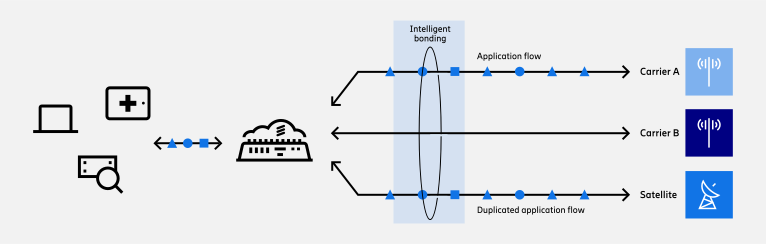
Why wait for plan B?
Most networks wait until something breaks, then switch to backup which can take minutes. Flow duplication sends your critical data down two paths at once. First one to arrive wins. If one path hits congestion or fails completely, you won't notice because the other copy was already on its way.
Use it when:
- A backup taking minutes to connect means a missed license plate hit, a dropped patient alert, or a garbled call
- You're moving between cell towers, crossing coverage boundaries, or operating in unreliable terrain
- The application matters more than the bandwidth cost
The 80/20 Rule, but for your network
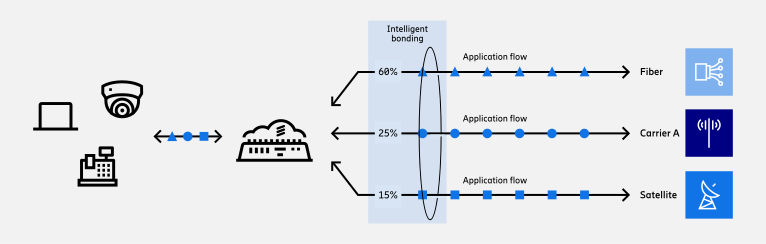
Not all traffic deserves first-class treatment. Your point-of-sale systems? Priority routing. Security cameras? Sure. Karen from accounting streaming her true crime podcast? That can take the scenic route.
Flow balancing lets you assign traffic by percentage across your connections or have the balancing done dynamically to adapt to changing needs. Business-critical apps get the fast lane. Everything else uses your cost-effective link—until that link actually fails, then it fails over intelligently.
Use it when:
- You're paying cellular rates and wondering why guest Wi-Fi is on LTE
- You want the system to dynamically balance workloads so you don't have to think about it
- Different locations have wildly different bandwidth and application needs
- You want surgical control without micromanaging every application
One link is a limit. Multiple links is a solution.
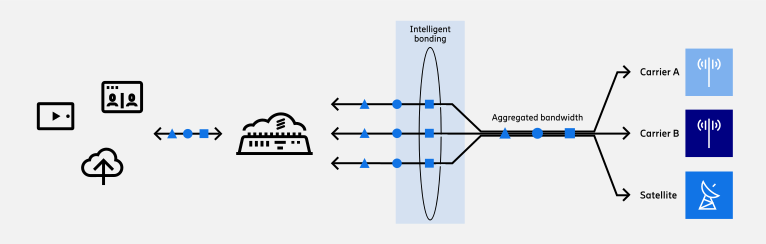
Your single connection maxes out at 25 Mbps. Your application needs 40 Mbps.
Bandwidth aggregation bonds two (or more) links together into one larger pipe. The video streams. The file uploads. The passengers get their Wi-Fi. Problem solved.
Use it when:
- You need to do large file uploads like video
- Individual links can't handle your bandwidth-intensive applications
- You need temporary high-capacity connectivity (events, emergencies, seasonal spikes)
The right network for every deployment

Vehicles in motion
Mobile networks don't do you any favors. You're constantly switching towers, crossing carrier boundaries, and hitting dead zones. If your critical systems need continuous connectivity, and they do, traditional failover will let you down right when it matters.
Dual-modem routers with flow duplication keep data moving across diverse cellular carriers or cellular and satellite simultaneously. When you need to stream video from multiple cameras during an incident, bandwidth aggregation gives you the capacity without the buffering wheel of doom.
Fixed locations using wireless WAN
Your location may be fixed, but it has a moving target of bandwidth demands. Morning: email and video calls. Midday: transactions and back-office processing. Evening: system updates and security footage uploads. Plus guest Wi-Fi for anyone who asks nicely (or doesn't).
Flow balancing routes each type of traffic intelligently. Critical systems take the highest performing link. High-volume, low-priority traffic stays off your metered connection. When the entire company joins a live stream or Black Friday hits, bandwidth aggregation keeps everything moving.


When temporary means right now
Emergency response doesn't have time for network setup. First responders are arriving. Command needs connectivity. Every system needs to be online before the situation evolves further.
Pre-configured intelligent bonding turns multiple connections into one reliable network in minutes. Flow duplication keeps command communications stable. Bandwidth aggregation supports dozens of devices connecting simultaneously.
Your network, your way
Some teams want cloud-delivered agility. Others need on-premises control. Both get the same intelligent bonding capabilities. Pick the model that fits your infrastructure. The technology works either way.

Cloud delivered for simple deployment
Customer hosted, data residency control, and compliance-ready
Set it once, deploy everywhere
Configure your bonding policies in NetCloud Manager. Deploy them across 10 locations or 1,000. Monitor performance in real-time. Adjust based on what's actually happening, not what you thought would happen.
Application-aware routing. Real-time analytics. Automated failover. Cost tracking by location. All from one interface.
Because network complexity shouldn't require complex management.

See what intelligent bonding can do for you
Talk to someone who actually understands your network requirements. We'll skip the sales pitch.