
Cellular carriers have good reasons to invest in 5G for organizations
In July, Telstra unveiled the world’s first enterprise-grade 5G solutions. Telstra has a great 5G network, no doubt. But is offering 5G for business merely an afterthought? Is offering 5G business solutions a good investment for any network operator? I suggest there are two reasons why 5G business solutions should be part of every network operator’s revenue stream.
First, 5G is good at business
4G brought a watershed of applications to mobile phones that changed our world forever. However, 4G also created a new category of business connectivity: wireless for the WAN. Now Wireless WAN is deployed in hundreds of thousands of sites worldwide, from a primary Internet connection to a failover component in an SD-WAN deployment.
While the growth of 4G has been impressive, 5G promises to be a more significant disruptor for business. Here are the principal capabilities that 5G will bring to the table:
- Fiber-fast performance
- Ultra-low latency
- Massive IoT reach
- Practical edge computing
- Network slicing
- Private 5G
Supporting the performance bullet, the Speedtest Global Index for July 2020 reports that the global average fixed broadband (wired) download speed was 81 Mbps while the global average download speed for mobile (wireless) was 35 Mbps. This means currently wired broadband is more than twice as fast as wireless globally. During close to the same period, Qualcomm reported global 5G Sub-6 speeds were twice as fast and 5G mmWave speeds that were 11 times faster than the average fixed broadband speeds shown in the Speedtest report.
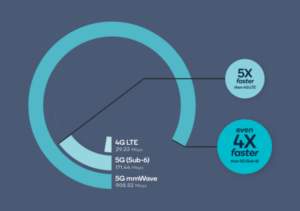
SOURCE: https://www.qualcomm.com/products/5g/5g-speeds
Organizations will quickly take notice. The increase in speed and capabilities will significantly improve current Wireless WAN use cases. Some say the killer apps for 5G are the ones you’re running today. That said, 5G will also unearth new business cases such as AI applied to video, augmented reality, and autonomous applications.
Pessimists may say these use cases are years away. That may be true for technology-lagging companies, but 4G taught us that innovation begins the moment the opportunity surfaces — think how Uber and Lyft turned the transportation-for-hire industry upside down in a few short years. Wireless failover is another example. Just ask any retailer that kept its cash register ringing when fiber was cut during a busy holiday season.
The bottom line is that our current global environment is ripe for innovation in the wide-area network.
Second, 5G is good for business
So, why would a network operator proactively invest in 5G for business instead of letting crumbs fall from the consumer table? Because business revenue is the best type of revenue.
As network operators know, business metrics are generally better than consumer metrics — think margins, turnover, payment timeliness, and customer service. 5G offers an opportunity to create greater business stickiness, increased share of wallet, and value-added services. It is in the best interest of operators to start locking in customers by serving as a trusted 5G advisor now.
By combining a 5G core and edge strategy, network operators can start to deliver differentiated services over the top (OTT) instead of being relegated to a dumb pipe. In the consumer space, operators are competing with Google, Apple, Facebook, and others to delivery compelling OTT services. In the B2B space, operators have an opportunity to deliver innovative OTT services one slice at a time.
Many network operators have both wired and wireless business practices, with wired having the largest share. Instead of gradually losing wired business to another wireless provider, network operators should consider playing both sides of the wired/wireless fence and preserve and even grow their business customer base as this transition moves forward.


