
How flow duplication, flow balancing, and bandwidth aggregation maximize every connection across cellular, satellite, and beyond
Most of us don’t think twice about being connected until something breaks. And when it does, it’s rarely a convenient moment. For industries where vehicles are constantly on the move, branches need to be online in minutes, and first responders depend on a connection to save lives; downtime is not an option.
Historically, that’s where SD-WAN has played a key role. It gives teams centralized control over how network traffic flows, helping them keep critical applications running. Now, as more organizations shift to wireless-first environments — incorporating LTE, 5G, and even LEO satellite into their WAN — that control needs to go further. Intelligent bonding builds on SD-WAN to keep connections stable, even when networks are not.
At its core, intelligent bonding combines multiple WAN connections into a single virtual connection to increase resiliency, performance, available bandwidth, and cost-effectiveness. The result is more uptime, smoother app performance, and fewer disruptions for users.
Here, we’ll break down what makes wireless SD-WAN different from its wired counterpart, what intelligent bonding does behind the scenes, and why it’s becoming essential in use cases such as emergency response vehicles, mobile fleets, and temporary business sites.
Wired vs. wireless: Why smarter traffic management is needed
To understand the impact of intelligent bonding, it helps to first contrast SD-WAN in wired versus wireless environments.
SD-WAN has been around for a while and was originally built for wired networks, such as fiber, DSL, and MPLS. These connections typically behave in predictable ways, making it easier to steer traffic and plan for speed, latency, and reliability.
Wireless, however, is a different story. Whether you’re working with LTE, 5G, Wi-Fi, or LEO satellite, signal strength and bandwidth can change minute to minute, especially if your “office” is a moving vehicle. Bandwidth may fluctuate; signal strength varies with movement, and coverage gaps can cause sudden drops in connectivity.
One of the biggest differences between wired and wireless connectivity is what inputs SD-WAN uses to make traffic decisions. In wired networks, inputs such as latency, packet loss, and jitter drive traffic steering. In wireless networks, however, signal strength becomes just as important. Because signal quality varies constantly, SD-WAN needs to account for these changes and dynamically adjust traffic.
That’s what makes wireless SD-WAN different. It requires intelligence capable of understanding how changing conditions affect application performance and responding instantly when a link degrades. Intelligent bonding builds on that capability to help maintain performance, even as conditions change.
What is intelligent bonding?
Intelligent bonding is the brain behind your network connections. It combines two or more WAN links — cellular, satellite, or wired — into a single, logical connection. But what sets it apart from wired bonding is its use of cellular intelligence to make dynamic decisions about traffic distribution. It’s not just about bonding links to increase bandwidth. Rather, it considers factors such as signal strength from a specific tower, carrier link performance, cost differences between links, and application sensitivity to create resilient connections for mission-critical communications.
Learn how Ericsson Enterprise Wireless intelligent bonding solutions bring increased control over applications across the WAN.
Three modes of intelligent bonding
To understand how intelligent bonding works and where it is most effective, it’s helpful to explore its three bonding modes: flow duplication, flow balancing, and bandwidth aggregation.
Flow duplication for high resiliency
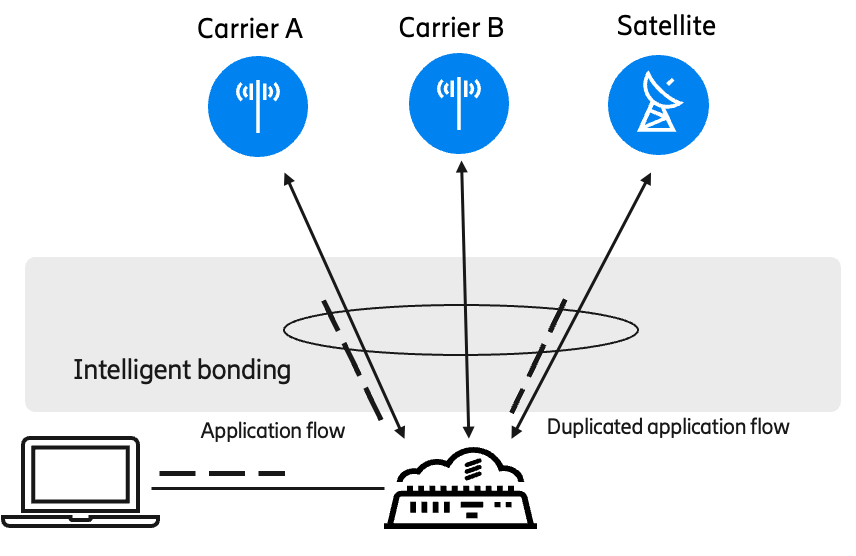
Flow duplication is perhaps the least understood but one of the most powerful modes. In this mode, identical packets are sent over two links at the same time. Even if a packet is lost on one link due to a temporary signal drop, the packet on the other link gets through, ensuring the application remains connected. This is especially useful for critical and latency-sensitive applications like VoIP (Voice Over IP), where even momentary drops can degrade communication. While this may not seem bandwidth-efficient, it offers near-100% reliability for sensitive applications by eliminating the risk of packet loss due to network instability.
Flow balancing for cost savings
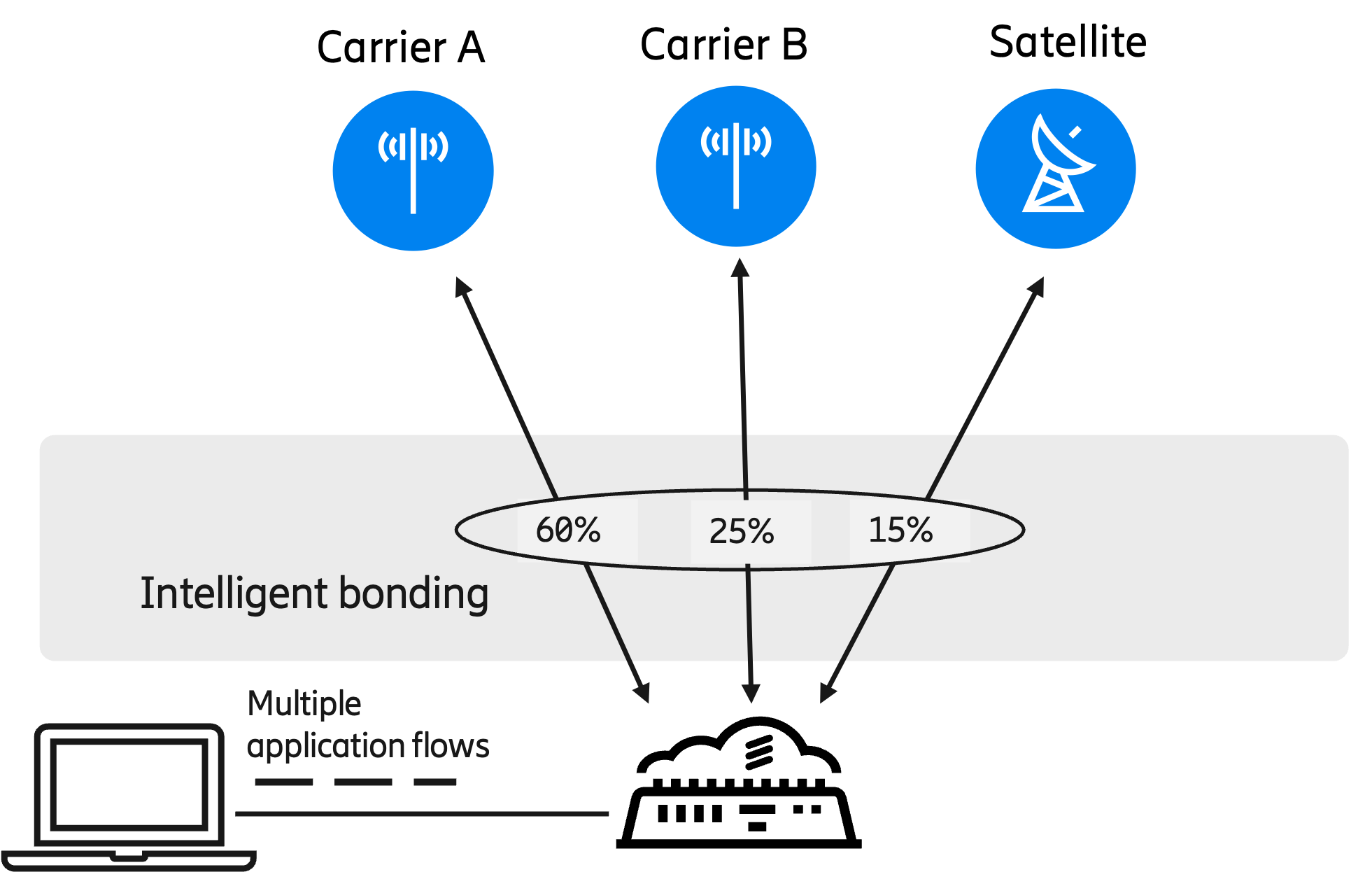
Flow balancing, on the other hand, is about distributing traffic flows across multiple links. This can be based on predefined, user-defined, or dynamic allocation percentages. In a user-defined example, a fleet vehicle operating in remote locations might send 15% of its traffic over a slower and more expensive satellite link and 85% over cellular links. This optimizes cost and performance, reserving the faster, cheaper, or more reliable link for the bulk of activity while ensuring redundancy. In a dynamic flow balancing example, the organization may have links from two carriers. The carrier with the better-quality link would gradually pick up additional portions of the traffic.
In fixed sites, the same principle applies — balancing between cellular providers and wired links, based on defined or dynamic policies. Organizations may want to use metered data plans only for lower bandwidth or business-critical applications. When choosing links and configuring them, network and IT managers should be aware that if one of the two bonded links fails, all traffic will automatically spill over to the other link.
Bandwidth aggregation for high bandwidth
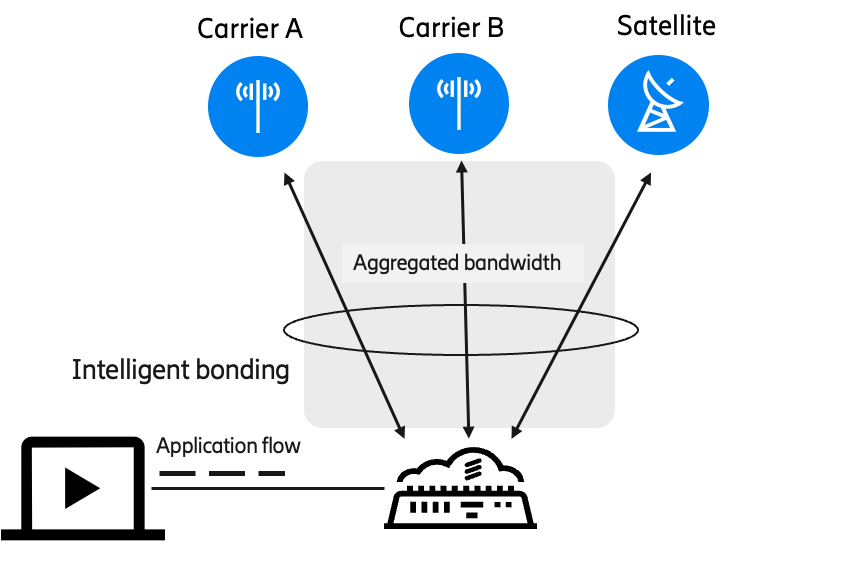
Bandwidth aggregation is the feature most associated with link bonding. It involves combining two or more WAN links to increase the overall bandwidth available for large data transfers. In practice, this doesn’t always result in a simple doubling of speed due to network overhead and router throughput limits, but it can significantly boost performance for large file uploads or real-time video uploads.
It’s important to note, however, that the latency of the aggregated bandwidth is determined by the slowest of the two links. Thus, it’s ideal to use two links with similar latency.
Intelligent bonding in the real world: CalFire
California’s Department of Forestry and Fire Protection (CalFire) demonstrates intelligent bonding in action. With a large fleet of fire trucks and equipment operating in remote areas, maintaining continuous connectivity is critical for their mission. CalFire vehicles are equipped with Ericsson Cradlepoint routers that include dual modems and Ethernet-connected satellite links.
With dual modems and real-time signal monitoring, the router can perform fast link failover in subsecond timeframes — something a basic dual-SIM failover solution without SD-WAN cannot achieve. In addition, using flow duplication for latency-sensitive applications such as VoIP enables clear, uninterrupted calls and real-time situational awareness, even in the most remote terrain.
This setup allows CalFire to utilize cellular providers and satellite simultaneously. In many deployments, they use flow duplication to send critical data over both links, dramatically increasing the likelihood of successful delivery. Whether transmitting GPS location, live video, or operational status, CalFire ensures its teams stay connected, helping save lives and protect communities.
As enterprises continue to expand into wireless-first and mobile environments, the ability to intelligently manage and bond multiple WAN links will become increasingly vital. From emergency response to mobile fleets and retail pop-ups, the use cases are expanding rapidly.
Ready to see intelligent bonding in action? Schedule a meeting with a networking expert.


